Publications

1. Small-Field DosimetryxReset
  • Characterization of a 0.5 × 0.5 mm plastic scintillating detector (HYPERSCINT) for small field dosimetry – Its performance and comparison with other commercially available plastic scintillating detectors

    This peer-reviewed study demonstrates the performance of new HYPERSCINT MICRO Series Medscint’s 0.5 × 0.5 mm plastic scintillating detector (one of our smallest and most precise model) designed specifically for ultra-small field dosimetry in stereotactic radiosurgery (SRS) and other high-precision radiotherapy applications.

    This ultra-compact detector enables real-time dose measurement with water-equivalent response, eliminating the need for correction factors even in sub-centimeter fields.

    Compared to other commercial detectors, the Medscint MICRO Series shows superior accuracy and minimal volume averaging, making it ideal for TrueBeam LINAC, cone factor validation, and advanced radiation therapy QA. Its high spatial resolution and compatibility with multi-channel setups allow for flexible and efficient workflows in both clinical and research environments.

    This innovation positions Medscint at the forefront of FLASH radiotherapy, small field characterization, and preclinical dosimetry, offering unmatched precision for modern radiation oncology.

    The Journal of Applied Clinical Medical Physics (JACMP)
    Milad Baradaran-Ghahfarokhi, Beshoi Grees, Annie Cooney, Erica Northern, George Ding, Guozhen Luo, Kenneth Homann | Department of Radiation Oncology, Vanderbilt University Medical Center, Nashville, Tennessee, USA
  • 🏆 Best Paper of the Year Award – Field output correction factors using a fully characterized plastic scintillation detector (HYPERSCINT)

    As small fields become increasingly important in radiation therapy, accurate dosimetry is essential for ensuring precise dose calculation and treatment optimization. Despite the availability of small volume detectors, small field dosimetry remains challenging. The new plastic scintillation detector (PSD) from the HYPERCINT RP-200 platform from Medscint offers a promising solution with minimal correction requirements for small field measurements.

    This study focused on characterizing the field output correction factors of the PSD across a wide range of field sizes and demonstrating its potential for determining correction factors for other small field detectors. Monte Carlo simulations and experimental comparisons were used to assess the system’s performance. The PSD exhibited near-unity correction factors (1.002 to 0.999) across field sizes between 0.6×0.6 cm² and 30×30 cm², with an impressive total uncertainty of 0.5%.

    The PSD is shown to be a highly accurate and reliable detector for small field dosimetry, and it can also be used to determine correction factors for other dosimeters with great precision.

    MEDICAL PHYSICS (AAPM)
    Luc Gingras (1,2), Yunuen Cervantes (1,2,3), Frederic Beaulieu (1,2), Magali Besnier (1,2), Benjamin Coté (4), Simon Lambert-Girard (4), Danahé LeBlanc (4), Yoan LeChasseur (4), François Therriault-Proulx (4), Luc Beaulieu (1,2,3), Louis Archambault (1,2,3) | 1. CHU de Québec–Université Laval, Québec – Canada, 2. Centre de recherche du CHU de Québec, Québec – Canada, 3. Université Laval, Québec – Canada, 4. Medscint, Québec – Canada
  • Radioluminescence-based fibre-optic dosimeters in radiotherapy: a review (incl. HYPERSCINT)

    In their comprehensive review, Veronese et al. examine the evolution and clinical application of radioluminescence-based fiber-optic dosimeters (FODs) in radiotherapy. These dosimeters have become essential tools in modern radiotherapy due to their capability for real-time, high-resolution dose measurements with minimal perturbation of the radiation field.

    The authors discuss a wide range of scintillating materials, their properties, and dosimetric performance. They provide a thorough comparison of various solutions for addressing the stem-effect, a critical issue in fiber-optic dosimetry. Solutions reviewed include the hyperspectral approach (utilized by Medscint’s HYPERSCINT system), twin-fiber subtraction, optical filtering, dual-channel spectral discrimination, temporal gating, air-core light guides, and real-time Optically Stimulated Luminescence (rtOSL). Notably, the hyperspectral technology employed by HYPERSCINT represents a major advancement, effectively overcoming many limitations of other approaches by offering superior accuracy, simplified calibration procedures, and enhanced robustness, particularly valuable in complex clinical scenarios.

    The review also emphasizes the growing adoption and diverse clinical applications of FODs, highlighting their significant role in improving treatment precision and patient safety. Clinical applications addressed in the review include small-field dosimetry, brachytherapy and in vivo dosimetry; advanced radiotherapy modalities such as intensity-modulated radiation therapy (IMRT), magnetic resonance-guided radiotherapy (MRgRT), hadron and proton therapies; and finally a special attention to MRI-Linac dosimetry and ultra-high dose rate (UHDR) or FLASH radiotherapy.

    Radiation Measurements
    Ivan Veronese (1), Claus E. Andersen (2), Enbang Li (3), Levi Madden (4), Alexandre M.C. Santos (5, 6, 7) | Department of Physics, University of Milan and National Institute for Nuclear Physics, Milano Unit, Italy, Department of Health Technology, Technical University of Denmark, Denmark, School of Physics, Faculty of Engineering and Information Sciences, University of Wollongong, Australia, Northern Sydney Cancer Centre, Royal North Shore Hospital, Australia, Australian Bragg Centre for Proton Therapy and Research, Australia, Radiation Oncology, Central Adelaide Local Heath Network, Australia, School of Physics, Chemistry and Earth Sciences, The University of Adelaide, Australia
  • Evaluation of the HYPERSCINT scintillation dosimetry platform for small-field characterization of a Leksell GAMMA KNIFE

    The performance of the HYPERSCINT RP-200 with the 0.5mm x 0.5mm detector was evaluated for the characterization of small radiation fields administered using a Leksell Gamma Knife Perfexion radiosurgery device. Overall, our results show that the detector response was in close agreement with Gamma Knife Monte Carlo reference data and film measurements. Based on the obtained results, the plastic scintillation detector shows the potential for rapid validation of output factors and validation of film measurements as well its use in challenging small-field situations encountered with the Gamma Knife.

    ISRS 2024 – New York
    Mathieu GUILLOT (1), Patrick DELAGE (1), Vincent HUBERT-TREMBLAY (1), Francois THERRIAULT-PROULX (2), Danahé LEBLANC (2) | CHUS – Sherbrooke, Canada, Medscint – Québec, Canada
  • Development of End-to-End Preclinical Treatment Verification Procedures, Traceable to NPL Air Kerma Primary Standard

    Dosimetry audits are an important tool to improve quality of reported results and to support standardization of preclinical radiation research. This work presents how the combination of passive and active detectors, such as the real-time HYPERSCINT scintillation dosimetry solution, with anatomically correct mouse phantoms are adequate for the development of End-to-End dosimetry audits for the independent verification of preclinical radiation treatments.

    The traceability of the detectors’ calibration to primary standards strengthens the dosimetry chain in the validation of preclinical plans, and it is consistent with the current practice for dose traceability of clinical radiotherapy treatments. Their implementation at national and regional levels could lead to databases of anonymised records, which will positively impact the dissemination of best practices and sharing of validated results.

    6th Conference on small animal precision image-guided radiotherapy
    Ileana Silvestre Patallo (1), Rebecca Carter (2)(3), Andrew Nisbet (2), Anna Subiel (1), Giuseppe Schettino (1) | 1. National Physical Laboratory, UK, 2. University College London, UK, 3. Cancer Institut, UK
  • Characterization of a 0.8 mm³ Medscint Plastic Scintillator Detector System for Small Field Dosimetry

    The scintillator-based dosimetry system HYPERSCINT RP-200, coupled with a 0.8 mm³ plastic scintillator detector, demonstrated excellent dosimetric properties for small field radiation therapy, including good repeatability, dose linearity, and accuracy down to field sizes as small as 0.5 × 0.5 cm².

    Physics in Medicine & Biology
    Elena Timakova (1,2), Magdalena Bazalova-Carter (1) , Sergei Zavgorodni (2) | 1. University of Victoria, British Columbia, Canada, 2. BC Cancer Agency, Vancouver Island Centre, British Columbia, Canada
  • Use of a Commercial Plastic Scintillation Detector for Determination of Detector-Specific Small Field Output Correction Factors of Other Detectors

    The goal of this work is to determine small field output correction factors of various detectors using the HYPERSCINT plastic scintillation detector as a reference and to compare values with current available data. The simple and well understood composition and geometry of the scintillation detector make it ideal to be used as a reference detector for the evaluation of field output correction factors. Field size dependent correction factors have been extracted for different detectors and show limited discrepancies with current available data. This may potentially be attributed to inter detector variability or other methodological uncertainties in published data.

    2022 AAPM ANNUAL MEETING
    M.Besnier (1), F.Beaulieu (1), F.Berthiaume (1,2), Y.Cervantes Espinosa (1), B.Côté (2), S.Lambert-girard (1,2), D.Leblanc (1,2), Y.Lechasseur (2), F.Therriault-Proulx (2), L.Archambault (1), L.Beaulieu (1), L.Gingras (1) | 1- CHU de Quebec – Universite Laval, QC, Canada, 2- MEDSCINT, QC, Canada
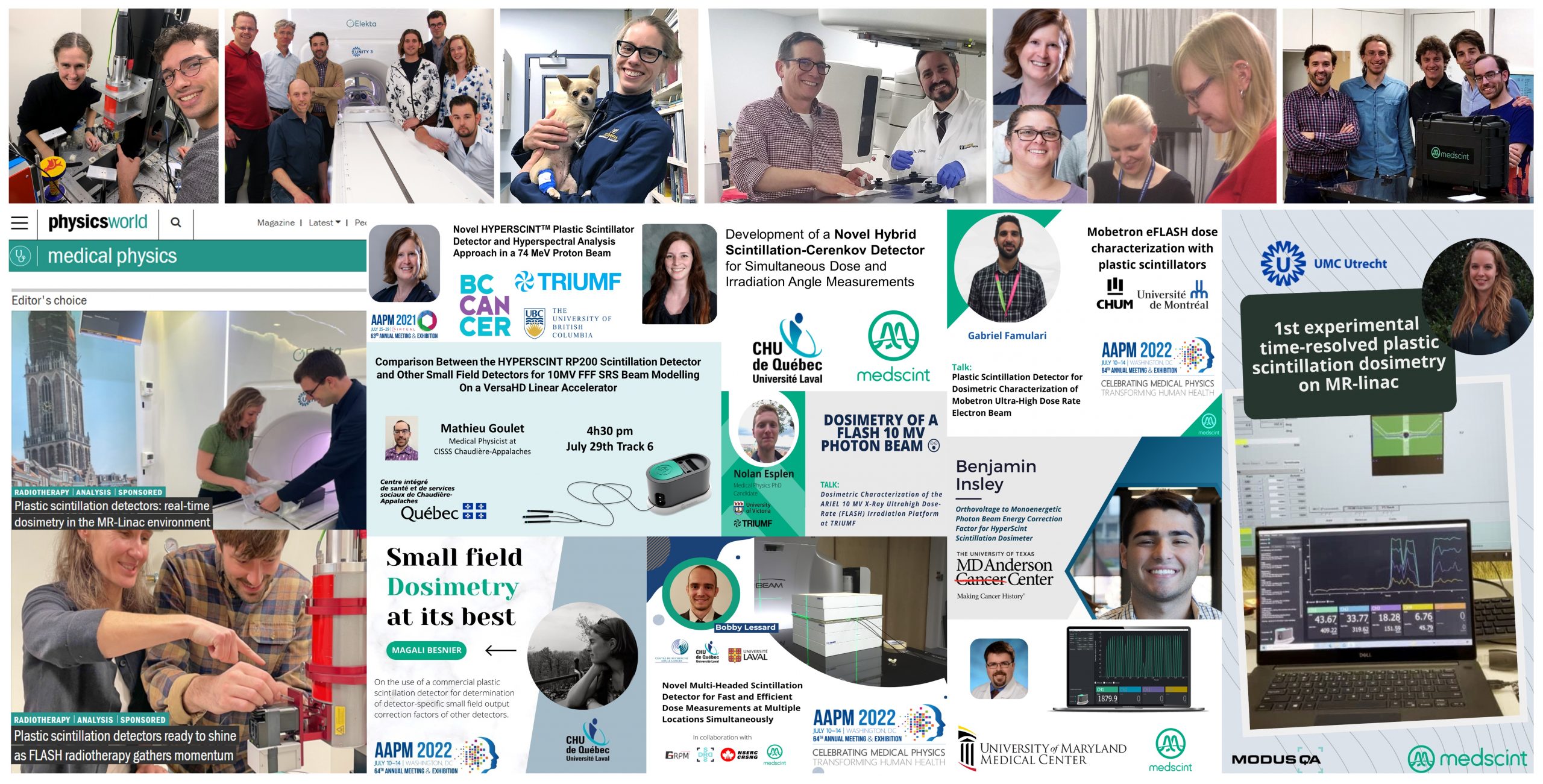
  • Plastic scintillation detectors ready to shine as FLASH radiotherapy gathers momentum.

    The team of University of Victoria’s XCITE Lab are using plastic scintillation detectors to provide real-time, small-field dosimetry in their FLASH radiotherapy experiments.

    PHYSICS WORLD
    | University of Victoria – XCITE Lab, Medscint
  • Comparison Between the HYPERSCINT RP200 Scintillation Detector and Other Small Field Detectors for 10MV FFF SRS Beam Modelling On a VersaHD Linear Accelerator

    Plastic scintillation detectors (PSDs) have advantageous dosimetric properties, including small size and energy independence, which make them ideal candidates for small field dosimetry.

    2021 AAPM ANNUAL MEETING
    J.Morin, JF.Cabana, M.Goulet, D.Theriault | CISSS – Chaudiere-Appalaches, Lévis, QC, CA
  • Investigations of a Novel HyperscintTM Plastic Scintillator Detector and Hyperspectral Analysis Approach in a 74 MeV Proton Beam

    The HYPERSCINT novel plastic scintillator with spectral analysis approach dosimetry system shows potential for dose measurement in a 74 MeV proton beam with negligible stem effect. The Cerenkov free spectrum may be used to facilitate calibration of the device in MV x-ray beams to improve Cerenkov removal and performance in small field dosimetry.

    2021 AAPM ANNUAL MEETING
    C.Duzenli (1), C.Hoehr (2), C.Belanger-champagne (2, C.Penner (3), V.Strgar (3) | 1- BC Cancer, BC, CANADA, 2- TRIUMF, BC, CANADA, 3- University of British Columbia, BC, CANADA
  • Beam matching for small-field dosimetry applications using accelerator solenoid current and a miniature plastic scintillation detector.

    The goal of this work is to determine the optimal accelerator solenoid current (ASOL) that minimizes the spread of measured small field output factor (OF) values between a series of machines. Small field OF measurements of 6 MV flattening filtered beams from 3 Varian TrueBeam linear accelerators were performed using a 1 mm diameter by 1 mm length plastic scintillation detector HYPERSCINT HS-RP200 research platform. In conclusion Small field dosimetry characteristics are highly sensitive to beam focal spot size. and the possibility to optimize accelerator focusing coil current to reduce OF and penumbra width spread enables new avenues in beam matching of series of machines, especially for SRS and SBRT techniques.

    2022 COMP ANNUAL SCIENTIFIC MEETING
    L.Gingras (1), F.Beaulieu (1), M.Besnier (1), B.Côté (2), D.Leblanc (2), L.Beaulieu (1), L.Archambault (1) | 1- CHU de Québec – Université Laval, QC, CA, 2- MEDSCINT, QC, CA
  • Dosimetric Characterization of the HYPERSCINT Scintillation Dosimetry Research Platform for Multipoint Applications

    Multipoint detectors are very interesting toward developing new phantoms and making measurements in constrained space. This study aims at assessing the performance of the HYPERSCINT dosimetry research platform (Medscint inc., Québec, Canada) with a high spatial resolution 3-point plastic scintillation detector for application to high energy photon beam dosimetry.

    2020 AAPM AM
    E.Jean, F.Therriault-Proulx, L.Beaulieu | CHU de Quebec – Universite Laval, QC, CA, Medscint, QC, CA , Centre Hospitalier Univ de Québec, Québec, QC, CA
  • Small field dosimetry of a Varian TrueBeam High Definition MLC linear accelerator using theHyperscint RP200 scintillation detector.

    Small field dosimetry of a Varian TrueBeam High Definition MLC linear accelerator using the Hyperscint RP200 scintillation detector.

    Purpose: To evaluate the performance of the new Hyperscint RP200 plastic scintillator for small field measurements of a Varian TrueBeam linear accelerator in comparison with the current state-of-the-art methodology in the clinic.

    Methods: Small field measurements were performed using different detectors: a diamond detector (microDiamond, PTW), a diode (Razor, IBA), a compact ion chamber (Razor, IBA), and a 1mm x 1mm
    plastic scintillation detector (Hyperscint RP200, Medscint). Correction factors based on measured field sizes, following TRS483 recommendations, were applied to all measurements. Output factors of a
    TrueBeam linear accelerator were measured for field sizes of 0.5 cm to 2 cm for jaws and MLC configurations for 6-MV, 6-MV FFF and 10-MV FFF photon beams. Output factors for different circular collimators (0.4 cm to 2 cm) were also obtained at 10-MV FFF. Scintillator measurements were compared to the small-field dosimetry methodology used clinically.

    Results: No correction factors were necessary for the plastic scintillation detector measurements. Scintillator measurements were within 1.1% of the standard methodology for all the small field geometries studied. Average relative differences were (0.3±0.5)%, (0.7±0.3)%, and (0.2±0.2)% for the 6-MV, 6-MV FFF, and 10-MV FFF, respectively. Output factors of circular field sizes down to 0.4-cm diameter were obtained with an average relative difference of (0.1±0.4)%, including a maximum difference of 0.7% for the smallest field.

    Conclusion: This new scintillation dosimetry research platform shows great promises for small field dosimetry. It has the potential to be used as part of a single-detector no-correction-factor methodology.

    2021 COMP ASM
    L.Gingras, B.Côté, F.Berthiaume, S.Lambert-Girard, D.Leblanc, L.Archambault, L.Beaulieu, F.Therriault-Proulx | CHU de Quebec – Universite Laval, QC, CA, Département de radio-oncologie et Axe Oncologie du CRCHU de Québec, QC, CA, MedScint, QC, CA