Publications

9. Advanced DosimetryxReset
  • Radiation damage and recovery of plastic scintillators under ultra-high dose rate 200 MeV electrons (VHEEs) at CERN CLEAR facility

    The team investigates the radiation damage and recovery of plastic scintillators under ultra-high dose rate (UHDR) conditions using 200 MeV electrons at the CERN CLEAR facility (VHEEs). Their findings highlight the challenges of accurate dosimetry in UHDR radiotherapy and explores the potential of plastic scintillation detectors (PSDs) for research and clinical applications using this innovative beam conditions and modality.

    HYPERSCINT, developed by Medscint, is uniquely positioned to address these challenges with its hyperspectral technology, enabling precise differentiation between scintillation and Cherenkov emissions. This innovation enhances dosimetry accuracy, making HYPERSCINT a valuable tool for advancing UHDR radiotherapy research and clinical implementation, including VHEEs.

    Physics in Medicine & Biology
    Cloé Giguère (1,2), Alexander Hart (3), Joseph Bateman (4), Pierre Korysko (4,5), Wilfrid Farabolini (5), Yoan LeChasseur (6), Magdalena Bazalova-Carter (3), Luc Beaulieu (1,2) | 1. Département de Physique, de Génie Physique et d’Optique et Centre de Recherche sur le Cancer, Université Laval – CANADA, 2. Département de Radio-Oncologie et Axe Oncologie du CRCHU de Québec, CHU de Québec, Université Laval – CANADA, 3. Department of Physics and Astronomy, University of Victoria – CANADA, 4. Department of Physics, University of Oxford – UK, 5. CERN – SWITZERLAND, 6. Medscint – CANADA
  • 🏆 Best Paper of the Year Award – Field output correction factors using a fully characterized plastic scintillation detector (HYPERSCINT)

    As small fields become increasingly important in radiation therapy, accurate dosimetry is essential for ensuring precise dose calculation and treatment optimization. Despite the availability of small volume detectors, small field dosimetry remains challenging. The new plastic scintillation detector (PSD) from the HYPERCINT RP-200 platform from Medscint offers a promising solution with minimal correction requirements for small field measurements.

    This study focused on characterizing the field output correction factors of the PSD across a wide range of field sizes and demonstrating its potential for determining correction factors for other small field detectors. Monte Carlo simulations and experimental comparisons were used to assess the system’s performance. The PSD exhibited near-unity correction factors (1.002 to 0.999) across field sizes between 0.6×0.6 cm² and 30×30 cm², with an impressive total uncertainty of 0.5%.

    The PSD is shown to be a highly accurate and reliable detector for small field dosimetry, and it can also be used to determine correction factors for other dosimeters with great precision.

    MEDICAL PHYSICS (AAPM)
    Luc Gingras (1,2), Yunuen Cervantes (1,2,3), Frederic Beaulieu (1,2), Magali Besnier (1,2), Benjamin Coté (4), Simon Lambert-Girard (4), Danahé LeBlanc (4), Yoan LeChasseur (4), François Therriault-Proulx (4), Luc Beaulieu (1,2,3), Louis Archambault (1,2,3) | 1. CHU de Québec–Université Laval, Québec – Canada, 2. Centre de recherche du CHU de Québec, Québec – Canada, 3. Université Laval, Québec – Canada, 4. Medscint, Québec – Canada
  • Radioluminescence-based fibre-optic dosimeters in radiotherapy: a review (incl. HYPERSCINT)

    In their comprehensive review, Veronese et al. examine the evolution and clinical application of radioluminescence-based fiber-optic dosimeters (FODs) in radiotherapy. These dosimeters have become essential tools in modern radiotherapy due to their capability for real-time, high-resolution dose measurements with minimal perturbation of the radiation field.

    The authors discuss a wide range of scintillating materials, their properties, and dosimetric performance. They provide a thorough comparison of various solutions for addressing the stem-effect, a critical issue in fiber-optic dosimetry. Solutions reviewed include the hyperspectral approach (utilized by Medscint’s HYPERSCINT system), twin-fiber subtraction, optical filtering, dual-channel spectral discrimination, temporal gating, air-core light guides, and real-time Optically Stimulated Luminescence (rtOSL). Notably, the hyperspectral technology employed by HYPERSCINT represents a major advancement, effectively overcoming many limitations of other approaches by offering superior accuracy, simplified calibration procedures, and enhanced robustness, particularly valuable in complex clinical scenarios.

    The review also emphasizes the growing adoption and diverse clinical applications of FODs, highlighting their significant role in improving treatment precision and patient safety. Clinical applications addressed in the review include small-field dosimetry, brachytherapy and in vivo dosimetry; advanced radiotherapy modalities such as intensity-modulated radiation therapy (IMRT), magnetic resonance-guided radiotherapy (MRgRT), hadron and proton therapies; and finally a special attention to MRI-Linac dosimetry and ultra-high dose rate (UHDR) or FLASH radiotherapy.

    Radiation Measurements
    Ivan Veronese (1), Claus E. Andersen (2), Enbang Li (3), Levi Madden (4), Alexandre M.C. Santos (5, 6, 7) | Department of Physics, University of Milan and National Institute for Nuclear Physics, Milano Unit, Italy, Department of Health Technology, Technical University of Denmark, Denmark, School of Physics, Faculty of Engineering and Information Sciences, University of Wollongong, Australia, Northern Sydney Cancer Centre, Royal North Shore Hospital, Australia, Australian Bragg Centre for Proton Therapy and Research, Australia, Radiation Oncology, Central Adelaide Local Heath Network, Australia, School of Physics, Chemistry and Earth Sciences, The University of Adelaide, Australia
  • Temporal, spatial, and motion-included scintillation-based QA for an MR-linac

    Modern adaptive radiotherapy techniques enhance healthy tissue sparing but introduce increased treatment complexity, requiring precise dosimetric validation. To address this, the MRI⁴ᴰ scintillator cassette in collaboration with IBA QUASAR and MEDSCINT is an innovative device integrating four MR-compatible plastic scintillation detectors (PSDs) and a radiochromic film. This device seamlessly works with the IBA QUASAR MRI⁴ᴰ Motion Phantom for comprehensive spatial, temporal, and motion-included dosimetry.

    In this webinar, Prescilla Uijtewaal, PhD
    explains her experience with the solution, showcasing the performance of the HYPERSCINT RP-200 scintillation dosimetry research platform in a 1.5T MR-linac and demonstrate the capabilities of the MRI⁴ᴰ scintillator cassette, and more.

    WEBINAR – Physics World Magazine
    Prescilla Uijtewaal, Martin Fast | University Medical Center Utrecht (UMCU) – Netherlands
  • M-TAG: A Modular Teaching-Aid for Geant4

    The article introduces M-TAG, a Geant4-based simulation tool for various physics applications, comparing it with similar tools like GATE, TOPAS, and GAMOS. M-TAG was employed to model and validate the HYPERSCINT detector’s performance. Additionally, it was used as an educational tool to teach a new user how to simulate and test the Hyperscint detector using Geant4.

    Heliyon
    Liam Carroll (1,2), Shirin A. Enger (1,2) | 1. Medical Physics Unit, Department of Oncology, Faculty of Medicine, McGill University, Montreal, Quebec, Canada, 2. Lady Davis Institute for Medical Research, Jewish General Hospital, Montreal, QC, H3T 1E2, Canada
  • Investigation of temperature dependence of inorganic scintillators using the HYPERSCINT research platform

    The temperature dependence of four inorganic scintillation detectors was examined spectrally using the HYPERSCINT Research Platform 200 under 6 MV photon irradiations from a LINAC. After varying only the temperature of the detectors, all scintillators demonstrated linearity when the change in photon counts with temperature in the full-width at half maximum of their spectrum are integrated. Establishing the magnitude of the temperature dependence of the materials is critical to decide whether correction factors are required. This is especially true in applications such as brachytherapy, where detectors equilibrise to body temperature.

    Radiation Measurements
    Owen McLaughlin (1), Michael Martyn (1,2), Christoph Kleefeld (1), Mark Foley (1) | 1. Physics Unit, School of Natural Sciences, University of Galway, Galway, Ireland, 2. Galway Clinic, Doughiska, Galway, Ireland
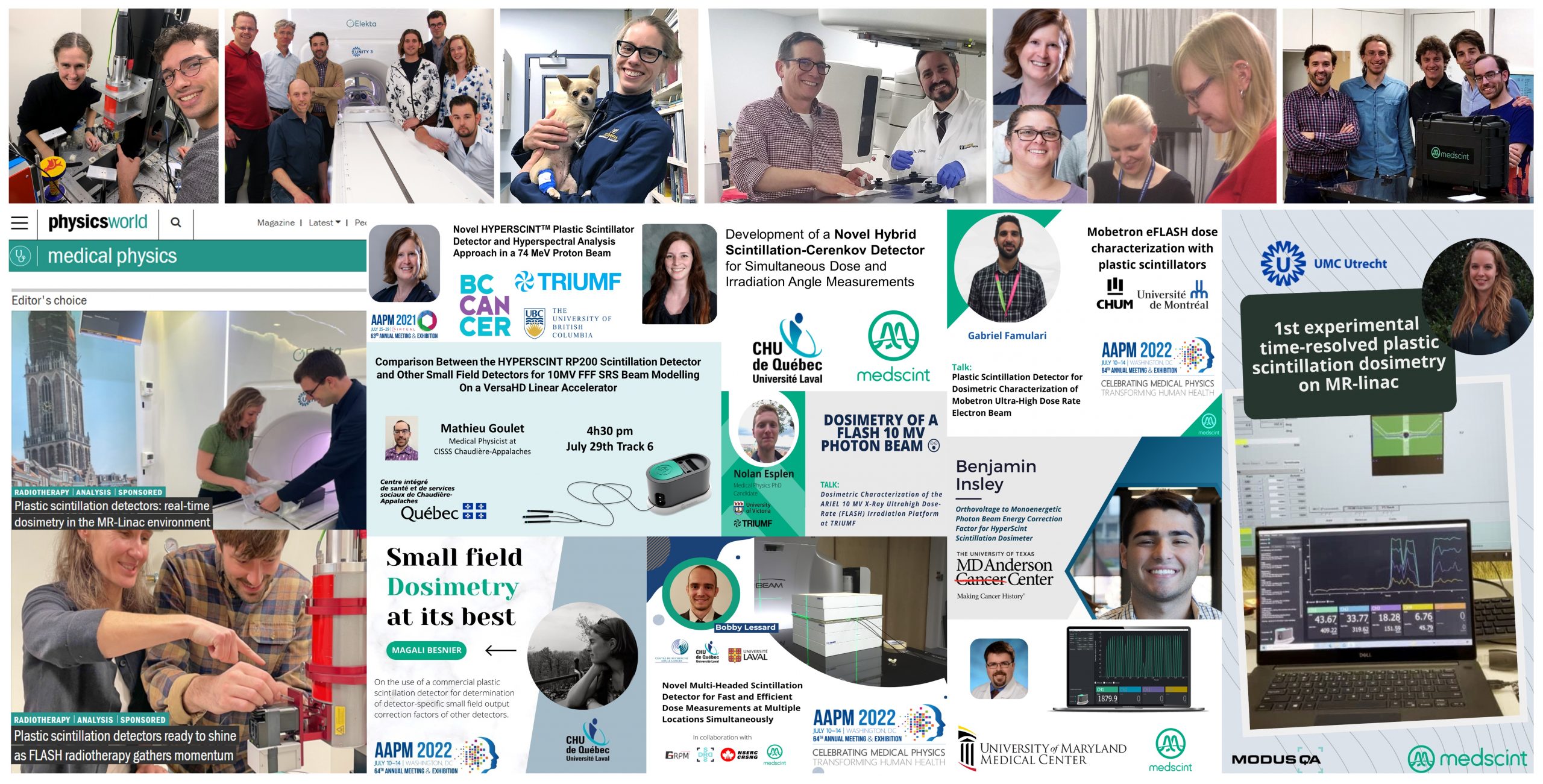
  • Plastic scintillation detectors: real-time dosimetry in the MR-Linac environment.

    Optical innovation meets clinical translation : in the vanguard of adaptive MR/RT research effort, the UMC Utrecht research team works with plastic scintillation detectors to bring MR-Linac treatment to the next level.

    PHYSICS WORLD
    | UMC Utrecht, Medscint
  • Plastic scintillation detectors ready to shine as FLASH radiotherapy gathers momentum.

    The team of University of Victoria’s XCITE Lab are using plastic scintillation detectors to provide real-time, small-field dosimetry in their FLASH radiotherapy experiments.

    PHYSICS WORLD
    | University of Victoria – XCITE Lab, Medscint
  • Investigations of a Novel HyperscintTM Plastic Scintillator Detector and Hyperspectral Analysis Approach in a 74 MeV Proton Beam

    The HYPERSCINT novel plastic scintillator with spectral analysis approach dosimetry system shows potential for dose measurement in a 74 MeV proton beam with negligible stem effect. The Cerenkov free spectrum may be used to facilitate calibration of the device in MV x-ray beams to improve Cerenkov removal and performance in small field dosimetry.

    2021 AAPM ANNUAL MEETING
    C.Duzenli (1), C.Hoehr (2), C.Belanger-champagne (2, C.Penner (3), V.Strgar (3) | 1- BC Cancer, BC, CANADA, 2- TRIUMF, BC, CANADA, 3- University of British Columbia, BC, CANADA
  • EFLASH Dosimetry On a Conventional Linac Using Pulse-Gated Delivery

    To build on previous experiments and improve reproducibility of electron FLASH delivery on a conventional linear accelerator, a pulse-gating circuit was constructed and tested with several dosimeters including : a 0.01cc volume ion chamber, optically stimulated luminescence dosimeters (OSLDs), Gafchromic MD film and a novel plastic scintillation detector with spectral analysis (HYPERSCINT).

    2021 AAPM ANNUAL MEETING
    C.Duzenli, C.Mendez, M.Petric, J.Sweeney, D.Ta, T.Karan | BC Cancer, Vancouver, BC, CANADA
  • On the nature of the light produced within PMMA optical light guides in scintillation fiber-optic dosimetry

    The goal of this study was to evaluate the nature of the stem effect light produced within an optical fiber, to quantify its composition, and to evaluate the efficiency of the chromatic technique to remove the stem effect. The chromatic stem effect removal technique is accurate in most of the situations. However, noticeable differences were obtained between very specific high-energy irradiation conditions. It would be advantageous to implement an additional channel in the chromatic stem effect removal chain or implement a spectral approach to independently remove the Cerenkov and the fluorescence components from the signal of interest. This would increase the accuracy and versatility of the actual chromatic stem effect removal technique.

    PHYSICS IN MEDICINE & BIOLOGY
    F.Therriault-Proulx (1)(2), L.Beaulieu (2)(3), L.Archambault (2)(3), S.Beddar (4)(1) | 1- Department of Radiation Physics, The University of Texas MD Anderson Cancer Center, Houston, TX, USA, 2- Département de Physique, de Génie Physique et d’Optique, Université Laval, Québec, Québec, Canada, 3- Département de Radio-Oncologie, Hôtel-Dieu de Québec, Centre Hospitalier Universitaire de Québec, Québec, Canada
  • On the use of a single-fiber multipoint plastic scintillation detector for 192Ir high-dose-rate brachytherapy

    The goal of this study was to prove the feasibility of using a single-fiber multipoint plastic scintillation detector as an in vivo verification tool during (192)Ir high-dose-rate brachytherapy treatments. The use of a multipoint plastic scintillation detector for high-dose-rate brachytherapy dosimetry is feasible. This detector shows great promise for development of in vivo applications for real-time verification of treatment delivery.

    MEDICAL PHYSICS
    F.Therriault-Proulx, S.Beddar, L.Beaulieu | Department of Radiation Physics, The University of Texas MD Anderson Cancer Center, Houston, TX, USA
  • Development of a novel multi-point plastic scintillation detector with a single optical transmission line for radiation dose measurement

    The goal of this study was to develop a novel multi-point plastic scintillation detector capable of measuring the dose accurately at multiple positions simultaneously using a single optical transmission line. This study demonstrates the practical feasibility of multi-point plastic scintillation detector. This type of detector could be very useful for pre-treatment quality assurance applications as well as an accurate tool for real-time in vivo dosimetry.

    PHYSICS IN MEDICINE & BIOLOGY
    F.Therriault-Proulx, L.Archambault, L.Beaulieu, S.Beddar | Department of Radiation Physics, The University of Texas MD Anderson Cancer Center, Houston, TX, USA, Département de Physique, de Génie Physique et d’Optique, Université Laval, Québec, Québec, Canada, Département de Radio-Oncologie, Hôtel-Dieu de Québec, Centre Hospitalier Universitaire de Québec, Québec, Canada
  • Review of plastic and liquid scintillation dosimetry for photon, electron, and proton therapy

    While scintillation dosimetry has been around for decades, the need for a dosimeter tailored to the reality of modern radiation therapy-in particular a real-time, water-equivalent, energy-independent dosimeter with high spatial resolution-has generated renewed interest in scintillators over the last 10 years. This topical review is intended to provide the medical physics community with a wide overview of scintillation physics, related optical concepts, and applications of plastic scintillation dosimetry.

    PHYSICS IN MEDICINE & BIOLOGY
    L Beaulieu (1,2), S Beddar (3,4) | 1- Département de physique, génie physique et optique, et Centre de recherche sur le cancer, Université Laval, Québec, CA , 2- Département de radio-oncologie et Axe Oncologie du CRCHU de Québec, QC, CA, 3- Department of Radiation Physics, The University of Texas MD Anderson Cancer Center, Houston, TX, USA, 4- The University of Texas Graduate School of Biomedical Sciences at Houston, Houston, TX, USA
  • Water-equivalent plastic scintillation detectors for high-energy beam dosimetry: II. Properties and measurements

    The properties of a new scintillation detector system for use in dosimetry of high-energy beams in radiotherapy have been measured. The most important properties of these detectors are their hgh spatial resolution and their nearly water-equivalence.

    PHYSICS IN MEDICINE & BIOLOGY
    A.S. Beddar, T.R. Mackie, F.H. Attix | Depanment of Medical Physics, University of Wisconsin Medical School, Madison, Wl, USA
  • Water-equivalent plastic scintillation detectors for high-energy beam dosimetry: I. Physical characteristics and theoretical consideration

    A minimally perturbing plastic scintillation detector has been developed for the dosimetry of high-energy beams in radiotherapy. The detector system consists of two identical parallel sets of radiation-resistant optical fibre bundles, each connected to independent photomultiplier tubes.

    PHYSICS IN MEDICINE & BIOLOGY
    A.S. Beddar, T.R. Mackie, F.H. Attix | Depanment of Medical Physics, University of Wisconsin Medical School, Madison, Wl, USA
  • A method to correct for temperature dependence and measure simultaneously dose and temperature using a plastic scintillation detector

    Plastic scintillation detectors work well for radiation dosimetry. However, they show some temperature dependence, and a priori knowledge of the temperature surrounding the plastic scintillation detectors is required to correct for this dependence.

    PHYSICS IN MEDICINE & BIOLOGY
    F.Therriault-Proulx, L.Wooton, S.Beddar | Department of Radiation Physics, The University of Texas MD Anderson Cancer Center, Houston, TX, USA
  • Orthovoltage to Monoenergetic Photon Beam Energy Correction Factor for HyperScint Scintillation Dosimeter

    The scintillator dosimetry system is a small-field dosimeter with reported energy independence down to 100-keV. This work investigates the energy dependence of the scintillator between a monoenergetic photon source and polyenergetic orthovoltage beam.

    2022 AAPM ANNUAL MEETING
    B. Insley, D. Bartkoski, L. Che Fru, M. Salehpour | M.D. Anderson Cancer Center, Houston, TX
  • Dosimetric Characterization of the ARIEL 10 MV X-Ray Ultrahigh Dose-Rate (FLASH) Irradiation Platform at TRIUMF

    The purpose was to characterize the beam delivery capabilities and dose rates achievable on the new ultrahigh dose-rate 10MV x-ray irradiation platform at TRIUMF. Beam commissioning and dosimetry have been conducted on the ARIEL x-ray FLASH irradiation platform using film doses and scintillators. Measured dose rates support that the 10MV x-ray beam may be used as a UHDR source compatible with FLASH radiobiological experiments.

    2022 AAPM ANNUAL MEETING
    N.Esplen (1), L.Egoriti (2), T.Planche (3), A.Hart (1), B.Paley (3), C.Hoehr (3), A.Gottberg (3), M.Bazalova-Carter (1) | 1- University of Victoria, BC ,CA, 2- University of British Columbia, BC, CA, 3- TRIUMF, BC, CA
  • A Novel Multi-Headed Scintillation Detector for Fast and Efficient Dose Measurements at Multiple Locations Simultaneously

    To develop and quantify the performances of a novel multi-point scintillation detector having multiple heads connected to the same optical line, allowing real-time dose measurements simultaneously at 3 positions in non-contiguous space.

    2022 AAPM ANNUAL MEETING
    B.Lessard (1,2), Y.Lechasseur (3), S.Lambert-girard (3), F.Therriault-Proulx (3), L.Beaulieu (1,2), L.Archambault (1,2) | 1- Département de physique, génie physique et optique, et Centre de recherche sur le cancer, Université Laval, Québec, CA , 2- CHU de Quebec – Universite Laval, QC, Canada, 3- MEDSCINT, QC, Canada
  • External beam irradiation angle measurement using Cerenkov emission

    In this study, we propose a novel approach designed to take advantage of the Cerenkov angular dependency to perform a direct measurement of an external beam radiation angle of incidence. The detector offers promising perspectives for external beam radiotherapy and brachytherapy applications.

    MEDICAL PHYSICS
    E.Jean (1,2,3), S.Lambert-girard (4), F.Therriault-Proulx (4), L.Beaulieu (1,2) | 1- Département de physique, génie physique et optique, et Centre de recherche sur le cancer, Université Laval, QC, Canada, 2- Département de radio-oncologie et Axe Oncologie du CRCHU de Québec, QC, CA, 3- Département de radio-oncologie du CIUSSS-MCQ, CHAUR de Trois-Rivières, QC, Canada, 4- MEDSCINT, QC, Canada
  • Comparative optic and dosimetric characterization of the HYPERSCINT scintillation dosimetry research platform for multipoint applications

    This study introduces the HYPERSCINT research platform (HYPERSCINT-RP100, Medscint Inc., Quebec, Canada), the first commercially available scintillation dosimetry platform capable of multi-point dosimetry through the hyperspectral approach.

    Phys Med Biol. 2021
    E.Jean (1,2,3), F.Therriault-Proulx (4), L.Beaulieu (1,2) | Département de physique, génie physique et optique, et Centre de recherche sur le cancer, Université Laval, Québec, CA , Département de radio-oncologie et Axe Oncologie du CRCHU de Québec, QC, CA, Département de radio-oncologie du CIUSSS-MCQ, CHAUR de Trois-Rivières, Trois-Rivières, QC, Canada, MedScint, QC, CA
  • Development of An Automated Routine for Finding the Precise Location of Scintillators Elements and Their Emission Spectrum in a Multi-Point Scintillation Detector

    The goal of this study is to develop an approach allowing for calibration of multi-point scintillation detector (mPSD) using only the photon beam from a linear accelerator such that it doesn’t depend on the availability of other irradiation modalities (e.g. orthovoltage irradiators). This study also aims at determining an experimental method to validate the spatial position of the different scintillators within the mPSD.

    2020 AAPM AM
    B.Lessard (1,2), F.Larose (1,2), F.Berthiaume (1,2,3), S.Lambert-girard (1,2,3), F.Therriault-Proulx (3), L.Archambault (1,2) | Département de physique, génie physique et optique, et Centre de recherche sur le cancer, Université Laval, Québec, CA , CHU de Quebec – Universite Laval, QC, CA, MedScint, QC, CA
  • Deformable Scintillation Dosimeter: II. Real-Time Simultaneous Measurements of Dose and Tracking of Deformation Vector Fields

    This article introduces a novel deformable dosimeter that can measure the dose distribution and track the deformation of a material during radiotherapy treatments using the HYPERSCINT dosimetry system. The dosimeter is made of an array of 19 scintillating fiber detectors embedded in a cylindrical elastomer matrix. It is imaged by two pairs of stereoscopic cameras that record the position, angulation and dose of the scintillators.

    Physics in Medicine & Biology
    Emily Cloutier (1,2), Luc Beaulieu(1,2), Louis Archambault (1,2) | 1. Service de physique médicale et Axe Oncologie du Centre de recherche, CHU de Québec-Université Laval, Canada, 2. Département de physique, de génie physique et d’optique, et Centre de recherche sur le cancer, Université Laval, Québec, Canada
  • Real-time dosimetry of ultrahigh dose-rate x-ray beams using scintillation detectors

    FLASH radiation therapy using an ultrahigh dose-rate beam is found to eradicate tumours whilst significantly reducing radiation-induced tissue toxicity. A real-time dosimetry system is required for the technique to be implemented clinically and for further preclinical studies. This study aimed to optimize the design of scintillating detectors using inorganic materials for real-time dosimetry in ultrahigh dose-rate radiation applications. Inorganic scintillator detectors were fabricated using phosphor-based scintillating materials (Gd2O2S:Tb, La2O2S:Tb, and La2O2S:Eu) coupled with optical fibers. The initial results in ultrahigh dose-rate x-ray irradiation showed excellent linearity with signal independent of the dose rate and dose delivered. A hyperspectral approach is adopted in this study to account for the stem effect that occurs within the high energy typically used in radiotherapy.

    IEEE
    Shahirah Shaharuddin (1), Alexander Hart (2), Daniel D. Cecchi (2), Magdalena Bazalova-Carter (2), Mark Foley (1) | 1. School of Physics, National University of Ireland Galway, Ireland, 2. Department of Physics & Astronomy, University of Victoria, Canada