Publications

2. Adaptive-RT (ex. MR-LINAC)xReset
  • Radioluminescence-based fibre-optic dosimeters in radiotherapy: a review (incl. HYPERSCINT)

    In their comprehensive review, Veronese et al. examine the evolution and clinical application of radioluminescence-based fiber-optic dosimeters (FODs) in radiotherapy. These dosimeters have become essential tools in modern radiotherapy due to their capability for real-time, high-resolution dose measurements with minimal perturbation of the radiation field.

    The authors discuss a wide range of scintillating materials, their properties, and dosimetric performance. They provide a thorough comparison of various solutions for addressing the stem-effect, a critical issue in fiber-optic dosimetry. Solutions reviewed include the hyperspectral approach (utilized by Medscint’s HYPERSCINT system), twin-fiber subtraction, optical filtering, dual-channel spectral discrimination, temporal gating, air-core light guides, and real-time Optically Stimulated Luminescence (rtOSL). Notably, the hyperspectral technology employed by HYPERSCINT represents a major advancement, effectively overcoming many limitations of other approaches by offering superior accuracy, simplified calibration procedures, and enhanced robustness, particularly valuable in complex clinical scenarios.

    The review also emphasizes the growing adoption and diverse clinical applications of FODs, highlighting their significant role in improving treatment precision and patient safety. Clinical applications addressed in the review include small-field dosimetry, brachytherapy and in vivo dosimetry; advanced radiotherapy modalities such as intensity-modulated radiation therapy (IMRT), magnetic resonance-guided radiotherapy (MRgRT), hadron and proton therapies; and finally a special attention to MRI-Linac dosimetry and ultra-high dose rate (UHDR) or FLASH radiotherapy.

    Radiation Measurements
    Ivan Veronese (1), Claus E. Andersen (2), Enbang Li (3), Levi Madden (4), Alexandre M.C. Santos (5, 6, 7) | Department of Physics, University of Milan and National Institute for Nuclear Physics, Milano Unit, Italy, Department of Health Technology, Technical University of Denmark, Denmark, School of Physics, Faculty of Engineering and Information Sciences, University of Wollongong, Australia, Northern Sydney Cancer Centre, Royal North Shore Hospital, Australia, Australian Bragg Centre for Proton Therapy and Research, Australia, Radiation Oncology, Central Adelaide Local Heath Network, Australia, School of Physics, Chemistry and Earth Sciences, The University of Adelaide, Australia
  • Temporal, spatial, and motion-included scintillation-based QA for an MR-linac

    Modern adaptive radiotherapy techniques enhance healthy tissue sparing but introduce increased treatment complexity, requiring precise dosimetric validation. To address this, the MRI⁴ᴰ scintillator cassette in collaboration with IBA QUASAR and MEDSCINT is an innovative device integrating four MR-compatible plastic scintillation detectors (PSDs) and a radiochromic film. This device seamlessly works with the IBA QUASAR MRI⁴ᴰ Motion Phantom for comprehensive spatial, temporal, and motion-included dosimetry.

    In this webinar, Prescilla Uijtewaal, PhD
    explains her experience with the solution, showcasing the performance of the HYPERSCINT RP-200 scintillation dosimetry research platform in a 1.5T MR-linac and demonstrate the capabilities of the MRI⁴ᴰ scintillator cassette, and more.

    WEBINAR – Physics World Magazine
    Prescilla Uijtewaal, Martin Fast | University Medical Center Utrecht (UMCU) – Netherlands
  • Development and first implementation of a novel multi-modality cardiac motion and dosimetry phantom for radiotherapy applications

    Magnetic resonance guided radiation therapy (MRgRT) for real-time gating around the heart for treating ventricular tachycardia (VT) are rapidly advancing. A novel, multi-modality modular heart phantom was developed and utilized in gated radiotherapy experiments on a 0.35 T MR-linac. This phantom can simulate cardiac, cardio-respiratory, and respiratory motions, and perform dosimetric evaluations using ionization chamber and plastic scintillation detectors (PSD from MEDSCINT) configurations.

    Due to their small sensitive volumes, time-resolved PSDs are effective for low-amplitude/high-frequency movements and multi-point data acquisition, enhancing dosimetric capabilities. This advancement in VT planning and delivery illustrates the phantom’s potential to meet the growing demands of cardiac applications in radiotherapy.

    MEDICAL PHYSICS
    Kenneth W. Gregg (1,2), Chase Ruff (1,2), Grant Koenig (3), Kalin I. Penev (3), Andrew Shepard (1), Grace Kreissler (4), Margo Amatuzio (4), Cameron Owens (4), Prashant Nagpal (5), Carri K. Glide-Hurst (1,2) | 1. Department of Human Oncology, University of Wisconsin–Madison, Madison, Wisconsin, USA, 2. Department of Medical Physics, University of Wisconsin–Madison, Madison, Wisconsin, USA, 3. Modus Medical Devices, Inc. (IBA QUASAR),London, Ontario, Canada, 4. Department of Biomedical Engineering, University of Wisconsin–Madison, Madison, Wisconsin, USA, 5. Department of Radiology, University of Wisconsin–Madison, Madison, Wisconsin, USA
  • Characterization of a multi-point scintillation dosimetry research platform for a low-field MR-Linac

    Plastic scintillation detectors (PSDs) are attractive for enhancing MRI-guided radiation therapy (MRgRT). A study evaluating the HYPERSCINT RP-200, a multi-probe PSD system, demonstrated excellent repeatability and minimal deviation in performance metrics such as detector response and percent depth dose (PDD). PSDs maintained consistent linearity across a broad range of monitor units and showcased high accuracy in gating experiments (ex. gating experiments where 400 cGy were delivered to isocenter : < 0.8 cGy variation for central axis measures and < 0.7 cGy for the gradient sampled region). These results highlight PSDs' huge potential in improving the precision and reliability of MRgRT, especially in complex real-time applications.

    MEDICAL PHYSICS
    Jennie Crosby (1), Chase Ruff (1), Ken Gregg (1), Jonathan Turcotte (2), Carri Glide-Hurst (1) | 1. Department of Human Oncology, University of Wisconsin-Madison, Madison, Wisconsin, USA, 2. Medscint, Québec, Quebec, Canada
  • MLC tracking and dose accumulation validation on the MR-linac using a real-time deformable dosimeter

    Online MRI on the MR-linac captures detailed anatomical movements, improving real-time radiotherapy adaptations. However, the lack of a suitable MRI-compatible phantom hinders workflow validation. This study introduces a deformable phantom with integrated real-time scintillation dosimeters, validating accuracy in MLC tracking and dose accumulation using the ELEKTA Unity MR-linac.

    This study demonstrates the vast potential of this novel prototype deformable phantom with integrated PSDs for real-time dosimetry measurements on an MR-linac.

    2024 ESTRO Annual Congress
    Madelon van den Dobbelsteen (1), Pim T.S. Borman (1), Laurie J.M. de Vries (1), Sara L. Hackett (1), Kalin Penev (1), Rocco Flores (2), Stephanie Smith (2), Yoan LeChasseur (3), Simon Lambert-Girard (3), Benjamin Côté (3) , Peter L. Woodhead (1)(4), Lando S. Bosma (1), Cornel Zachiu (1), Bas W. Raaymakers (1), Martin F. Fast (1) | 1 University Medical Center Utrecht, Radiotherapy, Utrecht, Netherlands., 2 IBA QUASAR, Modus Medical Devices Inc. London ON, Canada. , 3 Medscint, -, Quebec City, Canada. , 4 Elekta AB, -, Stockholm, Sweden.
  • Experimental dosimetric verification of the intra-fraction drift correction on the 1.5 T MR-linac

    MRI-guided online adaptive treatments can improve tumor targeting by adjusting treatment plans in real-time based on cine MR-scans. And to correct the intra-fraction motion, Elekta AB introduced the intra-fraction drift correction (IDC) functionality for the 1.5 T Unity MR-linac.

    The IDC is a valuable functionality for fast intra-fraction adaptations and this research experimentally verifies the geometric and dosimetric accuracy of the IDC process using film, scintillation, and diode dosimetry.

    ESTRO 2024 Annual Congress
    Madelon van den Dobbelsteen, Sara L. Hackett, Stijn Oolbekkink, Bram van Asselen, Prescilla Uijtewaal, Martin F. Fast, Bas W. Raaymakers | University Medical Center Utrecht, Radiotherapy, Utrecht, Netherlands
  • Performance characterization of a novel hybrid dosimetry insert for simultaneous spatial, temporal, and motion-included dosimetry for MR-linac

    The increased treatment complexity and the motion-delivery interplay during stereotactic body radiotherapy (SBRT) on an MR-linac treatments require MR-compatible motion phantoms with time-resolved dosimeters to validate end-to-end workflows. This study demonstrates the excellent suitability of a the Medscint novel hybrid film-scintillators cassette for simultaneous multi-spatial, temporal, and motion-included dosimetry.

    MEDICAL PHYSICS
    Prescilla Uijtewaal (1), Pim Borman (1), Benjamin Côté (2), Yoan LeChasseur (2), François Therriault-Proulx (2), Rocco Flores (3), Stephanie Smith (3), Grant Koenig (3), Bas Raaymakers (1), Martin Fast (1) | 1. Department of Radiotherapy, University Medical Center Utrecht, Utrecht, The Netherlands, 2. Medscint, Québec, Quebec, Canada, 3. Modus QA, London, Ontario, Canada
  • Performance of the HYPERSCINT scintillation dosimetry research platform for the 1.5 T MR-linac

    This study demonstrates the suitability of the HYPERSCINT PSD for accurate time- resolved dosimetry measurements in the 1.5 T MR-linac. The excellent performance during continuous MR scanning and during dynamic movement indicates the great potential of the detector to validate end-to-end workflows of online adaptive radiotherapy

    PHYSICS IN MEDICINE & BIOLOGY
    Prescilla Uijtewaal (1), Benjamin Côté (2), Thomas Foppen (1), J H Wilfred de Vries (1), Simon J Woodings (1), Pim T S Borman (1), Simon Lambert-Girard (2), François Therriault-Proulx (2), Bas W Raaymakers (1), Martin F Fast (1) | 1 – UMC Utrecht, Netherland, 2 – Medscint, Canada
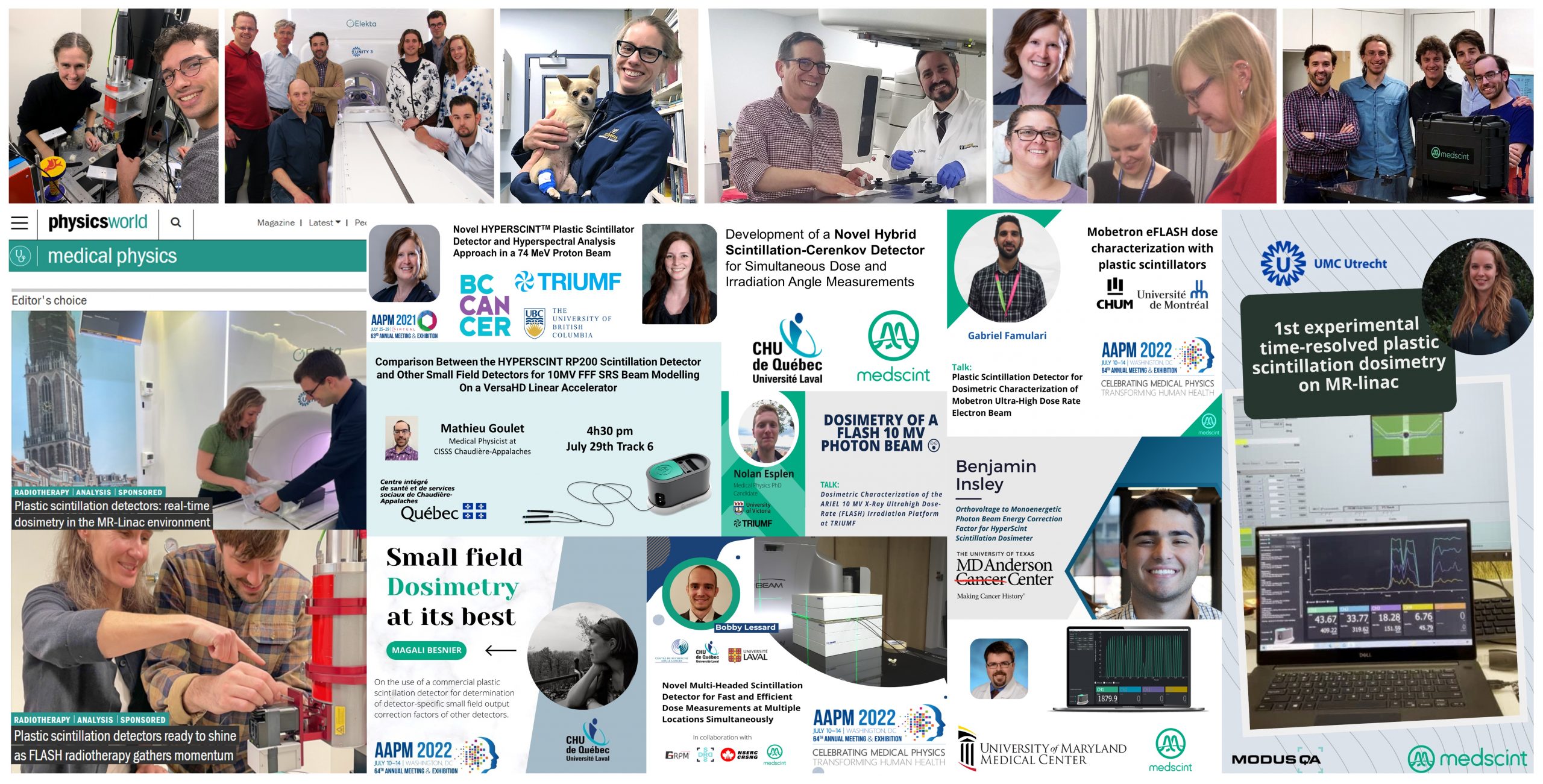
  • Plastic scintillation detectors: real-time dosimetry in the MR-Linac environment.

    Optical innovation meets clinical translation : in the vanguard of adaptive MR/RT research effort, the UMC Utrecht research team works with plastic scintillation detectors to bring MR-Linac treatment to the next level.

    PHYSICS WORLD
    | UMC Utrecht, Medscint
  • First Experimental Demonstration of Time-Resolved Plastic Scintillation Dosimetry On An MR-Linac

    In this study, UMC Utrecht research team demonstrates the feasibility of a hybrid experimental setup combining an innovative multipoint scintillator detector with film in a moving phantom quantifying MLC tracking for lung SBRT. The prototype cassette is capable of measuring dose (with film and 4 points scintillators simultaneously) during motion experiments, combining film dosimetry with time-resolved and absolute dosimetry.

    2022 AAPM ANNUAL MEETING
    P.Uijtewaal (1), P.Borman (1), B.Côté (2), Y.Lechasseur (2), J.Turcotte (2), S.Lambert-girard (2), P.Woodhead (1), S.Woodings (1), W.de Vries (1), R.Flores (3), S.Smith (3), B.Raaymakers (1), M.Fast (1) | 1 – UMC Utrecht, Netherland, 2 – Medscint, Canada, 3 – Modus Medical Devices, Canada
  • On the orientation independence of the HYPERSCINT scintillation dosimetry research platform in a MR-linac environment.

    The purpose of this work was to characterize the HYPERSCINT scintillation dosimetry research platform in a MR-linac environment, particularly with respect to its orientation. This study shows that the HYPERSCINT scintillation dosimetry platform can be used regardless of its orientation in a magnetic field environment. Together with its linearity to dose and dose-rate, the detector shows great promises for development of dosimetry solutions dedicated to the MR-Linac environment.

    2022 COMP ANNUAL SCIENTIFIC MEETING
    B.Côté (1), B.Raaymakers (2), S.Woodings (2), P.Uijtewaal (2), W.de Vries (2), S.Lambert-girard (1), F.Therriault-Proulx (1), M.Fast (2) | Medscint, Canada (1), UMC Utrecht, Netherland (2)