Publications

4. FLASH-RT / UHDRxReset
  • Comprehensive investigation of HYPERSCINT RP-FLASH scintillator for electron FLASH research

    This paper presents a comprehensive investigation of the HYPERSCINT RP-FLASH scintillator, designed for electron FLASH research. The study evaluates its performance in ultra-high dose rate (UHDR) electron beam dosimetry, with a focus on dose-rate independence, fast response times, and millisecond-resolved measurements. The scintillator system demonstrated high accuracy, minimal dependence on beam parameters, and effective calibration for clinical and research applications.

    Medical Physics
    Lixiang Guo (1), Banghao Zhou (1), Yi-Chun Tsai (1), Kai Jiang (2), Viktor Iakovenko (2), Ken Kang-Hsin Wang (1) | 1. Biomedical Imaging and Radiation Technology Laboratory (BIRTLab), Department of Radiation Oncology – University of Texas Southwestern Medical Center, Dallas, Texas, USA, 2. Department of Radiation Oncology, University of Texas Southwestern Medical Center, Dallas, Texas, USA
  • What’s in a Proton FLASH Beam? Characterizing Ultra-High Dose Rate Protons Using a Commercial Plastic Scintillator

    Plastic scintillation detectors show great promise for FLASH proton therapy, especially in tracking dose rates across varying depths. This study explored their performance in a scanned 250 MeV proton beam, comparing them to ionization chambers. The detectors responded linearly to both time and dose, with deviations under ±2%, and matched ion chamber readings within 2% up to 34 cm depth.

    Their fast resolution made it possible to measure real-time dose rate variations—critical for assessing the FLASH effect near the Bragg peak, where spot widening tends to reduce instantaneous dose rates. Despite expected quenching effects at deeper depths, scintillators provided valuable insights into how dose rate changes spatially, helping researchers evaluate the clinical viability of FLASH delivery beyond the plateau region.

    Radiation Research
    Yannick Poirier (1), Kevin E. Byrne (1, 2), Gulakhshan Hamad (1), François Therriault-Proulx (3), Kai Jiang (1), Wei Deng (1), Amit Sawant (1), Sina Mossahebi (1) | 1. University of Maryland School of Medicine, USA, 2. University of Galway, Ireland, 3. Medscint, Canada
  • Radiation damage and recovery of plastic scintillators under ultra-high dose rate 200 MeV electrons (VHEEs) at CERN CLEAR facility

    The team investigates the radiation damage and recovery of plastic scintillators under ultra-high dose rate (UHDR) conditions using 200 MeV electrons at the CERN CLEAR facility (VHEEs). Their findings highlight the challenges of accurate dosimetry in UHDR radiotherapy and explores the potential of plastic scintillation detectors (PSDs) for research and clinical applications using this innovative beam conditions and modality.

    HYPERSCINT, developed by Medscint, is uniquely positioned to address these challenges with its hyperspectral technology, enabling precise differentiation between scintillation and Cherenkov emissions. This innovation enhances dosimetry accuracy, making HYPERSCINT a valuable tool for advancing UHDR radiotherapy research and clinical implementation, including VHEEs.

    Physics in Medicine & Biology
    Cloé Giguère (1,2), Alexander Hart (3), Joseph Bateman (4), Pierre Korysko (4,5), Wilfrid Farabolini (5), Yoan LeChasseur (6), Magdalena Bazalova-Carter (3), Luc Beaulieu (1,2) | 1. Département de Physique, de Génie Physique et d’Optique et Centre de Recherche sur le Cancer, Université Laval – CANADA, 2. Département de Radio-Oncologie et Axe Oncologie du CRCHU de Québec, CHU de Québec, Université Laval – CANADA, 3. Department of Physics and Astronomy, University of Victoria – CANADA, 4. Department of Physics, University of Oxford – UK, 5. CERN – SWITZERLAND, 6. Medscint – CANADA
  • Radioluminescence-based fibre-optic dosimeters in radiotherapy: a review (incl. HYPERSCINT)

    In their comprehensive review, Veronese et al. examine the evolution and clinical application of radioluminescence-based fiber-optic dosimeters (FODs) in radiotherapy. These dosimeters have become essential tools in modern radiotherapy due to their capability for real-time, high-resolution dose measurements with minimal perturbation of the radiation field.

    The authors discuss a wide range of scintillating materials, their properties, and dosimetric performance. They provide a thorough comparison of various solutions for addressing the stem-effect, a critical issue in fiber-optic dosimetry. Solutions reviewed include the hyperspectral approach (utilized by Medscint’s HYPERSCINT system), twin-fiber subtraction, optical filtering, dual-channel spectral discrimination, temporal gating, air-core light guides, and real-time Optically Stimulated Luminescence (rtOSL). Notably, the hyperspectral technology employed by HYPERSCINT represents a major advancement, effectively overcoming many limitations of other approaches by offering superior accuracy, simplified calibration procedures, and enhanced robustness, particularly valuable in complex clinical scenarios.

    The review also emphasizes the growing adoption and diverse clinical applications of FODs, highlighting their significant role in improving treatment precision and patient safety. Clinical applications addressed in the review include small-field dosimetry, brachytherapy and in vivo dosimetry; advanced radiotherapy modalities such as intensity-modulated radiation therapy (IMRT), magnetic resonance-guided radiotherapy (MRgRT), hadron and proton therapies; and finally a special attention to MRI-Linac dosimetry and ultra-high dose rate (UHDR) or FLASH radiotherapy.

    Radiation Measurements
    Ivan Veronese (1), Claus E. Andersen (2), Enbang Li (3), Levi Madden (4), Alexandre M.C. Santos (5, 6, 7) | Department of Physics, University of Milan and National Institute for Nuclear Physics, Milano Unit, Italy, Department of Health Technology, Technical University of Denmark, Denmark, School of Physics, Faculty of Engineering and Information Sciences, University of Wollongong, Australia, Northern Sydney Cancer Centre, Royal North Shore Hospital, Australia, Australian Bragg Centre for Proton Therapy and Research, Australia, Radiation Oncology, Central Adelaide Local Heath Network, Australia, School of Physics, Chemistry and Earth Sciences, The University of Adelaide, Australia
  • High-throughput, low-cost FLASH: irradiation of Drosophila melanogaster with low-Energy X-rays using time structures spanning ConvDR and UHDR

    This article explores the potential of using low-energy X-rays to deliver ultrahigh dose-rate (UHDR) FLASH radiotherapy using Drosophila melanogaster as a model. For this they have compared the effects of UHDR (210 Gy/s) and conventional dose rates (0.2–0.4 Gy/s) on the eclosion and lifespan of fly larvae. The results showed that larvae treated with UHDR had higher survival rates and longer lifespans, particularly at intermediate doses, indicating a normal tissue-sparing FLASH effect.

    The Medscint scintillation dosimetry detector was used to measure the response to X-rays at a very high sampling rate to confirm the time structure of the delivered radiation (i.e. the pulse width and inter-pulse spacing). Along with film measurements, they also confirmed that the doses delivered with UHDR and CONV agreed within 0.1%.

    Journal of Radiation Research
    Alexander Hart (1), Jan P Dudzic (1), Jameson W Clarke (1), Jonathan Eby (2), Steve J Perlman (1), Magdalena Bazalova-Carter (1) | 1. University of Victoria, BC – CANADA, 2. University of Toronto, ON – CANADA
  • Characterization of a novel time-resolved, real-time scintillation dosimetry system (HYPERSCINT RP-FLASH) for ultra-high dose rate radiation therapy applications

    This study evaluates a novel scintillation dosimetry solution developed by Medscint for ultra-high dose rate (UHDR) radiotherapy, the HYPERSCINT RP-FLASH. The system was tested on an UHDR electron beamline, demonstrating dose linearity and independence from dose rate (1.8–1341 Gy/s) and dose per pulse (0.005–7.68 Gy) within ±3% tolerance. The system accurately measured doses per pulse up to 120 Hz.

    With daily calibrations and specific correction factors, the system provides real-time, millisecond-resolved dosimetric measurements for pulsed conventional and UHDR beams, showing promise for applications in FLASH-RT.

    Int. Journal of Rad. Onc Bio and Physics
    Alexander Baikalov (1,2,3), Daline Tho (1), Kevin Liu (1,4), Stefan Bartzsch (2,3), Sam Beddar (1,4), Emil Schüler (1,4) | 1. University of Texas MD Anderson Cancer Center, Houston, TX – USA, 2. Technical University of Munich – Germany, 3. German Research Center for Environmental Health, Neuherberg – Germany, 4. The University of Texas MD Anderson Cancer Center UTHealth Houston Graduate School of Biomedical Sciences, Houston, TX – USA
  • Plastic scintillator dosimetry of ultrahigh dose-rate 200 MeV electrons at CLEAR

    Very high energy electron (VHEE) beams with energies greater than 100 MeV may be promising candidates for FLASH radiotherapy due to their favourable dose distributions and accessibility of ultrahigh dose-rates (UHDR). The standard dosimeters used for conventional radiotherapy, including ionization chambers and film, have limited application to UHDR radiotherapy due to deficits in dose rate independence and temporal resolution. The performance of PSDs in this work suggest they may be useful real-time dosimeters for applications in UHDR VHEE radiotherapy.

    IEEE Xplore
    Alexander Hart (1), Cloé Giguère (2,6), Joseph Bateman (3,4), Pierre Korysko (3,4), Wilfrid Farabolini (3), Vilde Rieker (3,5), Nolan Esplen (1), Roberto Corsini (3), Manjit Dosanjh (3,4), Luc Beaulieu(2,6), Magdalena Bazalova-Carter (1) | 1. Department of Physics and Astronomy, University of Victoria, Victoria, BC, Canada, 2. Département de Physique, de génie Physique et d’optique et Centre de Recherche sur le Cancer, Université Laval, Quebec, QC, Canada, 3. CERN, Geneva, Switzerland, 4. Department of Physics, University of Oxford, Oxford, United Kingdom, 5. Department of Physics, University of Oslo, Oslo, Norway, 6. Département de radio-oncologie et Axe Oncologie duCRCHUde Québec, CHUde Québec – Universit é Laval, Quebec, QC, Canada
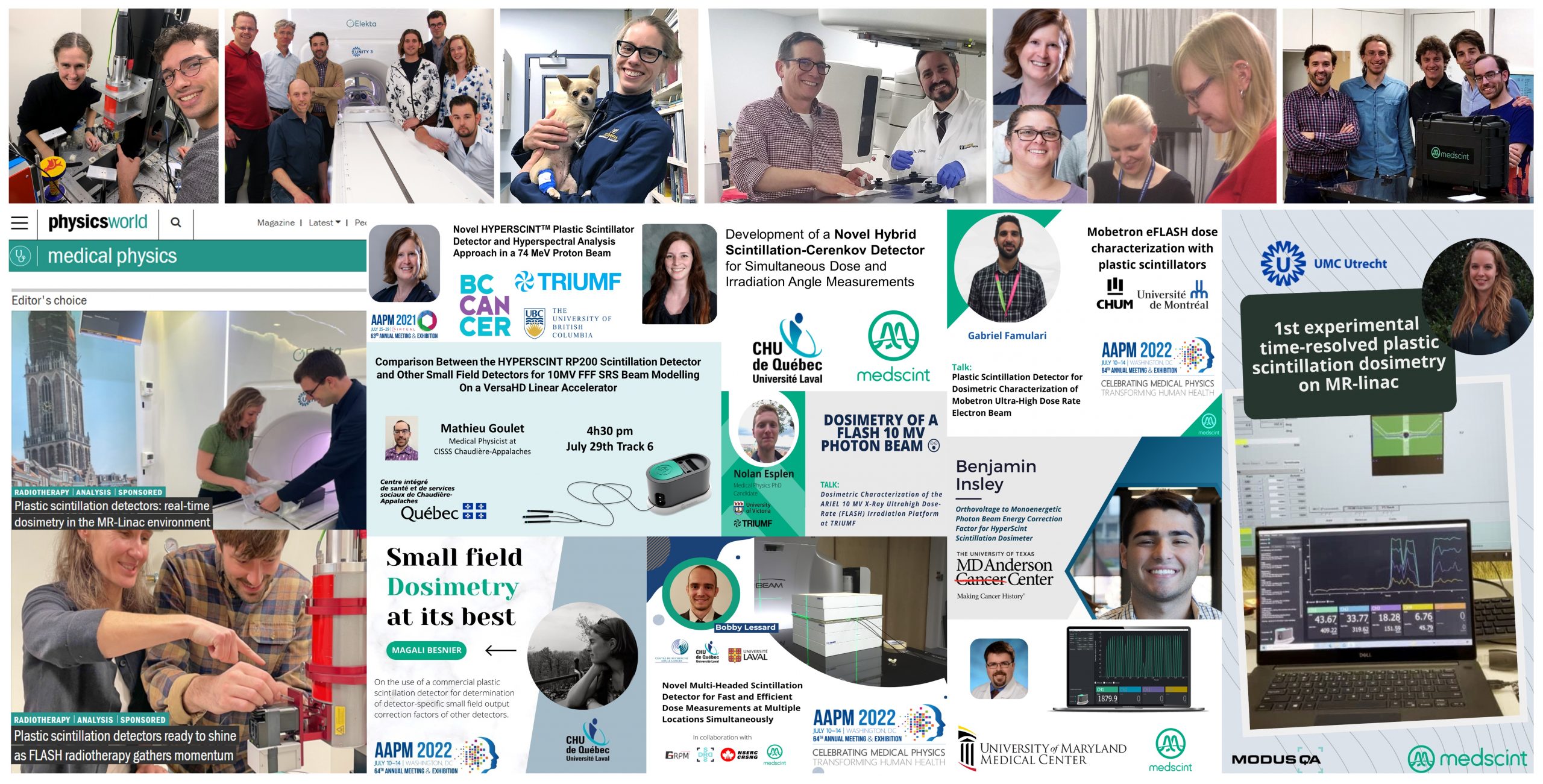
  • Plastic scintillation detectors ready to shine as FLASH radiotherapy gathers momentum.

    The team of University of Victoria’s XCITE Lab are using plastic scintillation detectors to provide real-time, small-field dosimetry in their FLASH radiotherapy experiments.

    PHYSICS WORLD
    | University of Victoria – XCITE Lab, Medscint
  • Implementation and validation of beam current transformer for Mobetron ultra-high dose rate electron beam monitoring using multi-detector approach

    To evaluate the performance of a custom beam current transformer (BCT) as a beam monitoring tool for the Mobetron electron radiation therapy system at ultra-high dose rates (UHDR) using a multi-detector comparison (plastic scintillators, ion chamber and film).

    2022 COMP ANNUAL SCIENTIFIC MEETING
    G.Famulari (1), K.Zerouali (1), J.Renaud (2), B.Muir (1), JF.Aubry (1), F.DeBlois (1), JF.Carrier (1) | 1 – Centre Hospitalier de l’Universite de Montreal (CHUM), Montreal, QC, CA, 2 – National Research Council Canada, Montreal, QC, CA
  • Technical note: Characterization and practical applications of a novel plastic scintillator for online dosimetry for an ultrahigh dose rate (FLASH)

    Although FLASH radiation therapy is a promising novel technique, the ultrahigh pulsed dose rates mean that experimental dosimetry is very challenging. The plastic scintillator shows a linear and reproducible response and is able to accurately measure the radiation absorbed dose delivered by 16-MeV electrons at UHPDR. The dose is measured accurately in real time with a greater level of precision than that achieved with a radiochromic film.

    Med Phys. 2022
    Y.Poirier (1,2), J.Xu (1), S.Mossahebi (1), F.Therriault-Proulx (3), A.Sawant (1) | 1- Department of Radiation Oncology, University of Maryland School of Medicine, Maryland, USA, 2- Department of Medical Physics, McGill University, Quebec, Canada, 3- MEDSCINT, Quebec, Canada
  • Characterization of a Novel Plastic Scintillator for Instant Real- Time Dosimetry in Electron FLASH-RT

    Purpose was to characterize and validate the novel HYPERSCINT RP100 plastic dosimeter as a direct pulse counter and investigate its use as a real-time in-vivo dosimeter in FLASH-RT radiobiological experiments. In conclusions, the HYPERSCINT RP100 dosimeter accurately measured the delivered radiation absorbed dose under both characterization and biological experimental conditions, with a higher degree of reliability than conventional radiochromic film. Furthermore, its 500 Hz measurement frequency could directly and accurately measure the number of pulses delivered in real time. This shows its potential for real-time in-vivo dosimetry to verify accurate delivery during biological experiments and clinical treatments.

    MEDICAL PHYSICS (AAPM)
    Y.Poirier (1), J.Xu (1), A.Ahmady (1), S.Mossahebi (1), H.Zhang (1), F.Therriault-Proulx (2), A.Sawant (1) | 1- University of Maryland School of Medicine, MD, USA , 2- McGill University, QC, Canada, 3- MEDSCINT, QC, Canada
  • Precise Pulse Delivery Control Using Monitor Units in Electron FLASH-RT

    In electron FLASH-RT, precise delivery of the correct number of pulses is critical to accurate dose administration in preclinical radiobiological studies. This work investigates the use of LINAC monitor ion chambers to most precisely control FLASH pulse delivery. Calibrated plastic scintillation detector and EBT-XD Gafchromic films were used for online and passive dosimetry, respectively. The plastic scintillation detector also served as a direct pulse counter.

    2021 AAPM ANNUAL MEETING
    J.Xu, Y.Poirier, A.Sawant | University of Maryland School of Medicine, MD, USA
  • Novel Plastic Scintillator for Online Dosimetry in Electron FLASH-RT

    The accurate delivery of electrons at FLASH-RT dose rates in radiobiological experiments require new dosimeters that are capable of accurately measuring the radiation dose delivered at >0.55 Gy per pulse (>100 Gy/s) in real-time. The novel HYPERSCINT RP100 plastic dosimeter was able to accurately measure the delivered radiation absorbed dose under characterization and biological experimental conditions, with a higher degree of reliability than conventional radiochromic film. Furthermore, it was shown to directly and accurately measure the number of pulses delivered in real time. This shows potential for use as a real-time in-vivo dosimeter during biological experiments, as well as potential clinical applications.

    2021 AAPM ANNUAL MEETING
    Y.Poirier (1), J.Xu (1), A.Ahmady (1), S.Mossahebi (1), H.Zhang (1), F.Therriault-Proulx (2), A.Sawant (1) | 1- University of Maryland School of Medicine, Baltimore, MD, USA , 2- MEDSCINT, QC, CANADA
  • Investigation of the HyperscintTM Plastic Scintillation Dosimetry System Performance in a 15 MeV electron beam at FLASH dose rates

    The performance of the HYPERSCINT plastic scintillation dosimetry system in a 15 MeV electron beam operating at FLASH dose rates was investigated. The linac produced a 15 MeV electron FLASH beam with an average dose rate of ~250 Gy/s and dose per pulse between 1 Gy and 1.7 Gy, at the level just above the multi-leaf collimator. The HYPERSCINT plastic scintillator detector system agreed with OSLDs within 3.5% for 10 to 20 pulse FLASH deliveries using the standard dose rate calibration for both dosimeters.

    2021 COMP ANNUAL SCIENTIFIC MEETING
    C.Mendez, P.Petric, T.Karan, C.Duzenli | BC Cancer, Vancouver, BC, CA
  • EFLASH Dosimetry On a Conventional Linac Using Pulse-Gated Delivery

    To build on previous experiments and improve reproducibility of electron FLASH delivery on a conventional linear accelerator, a pulse-gating circuit was constructed and tested with several dosimeters including : a 0.01cc volume ion chamber, optically stimulated luminescence dosimeters (OSLDs), Gafchromic MD film and a novel plastic scintillation detector with spectral analysis (HYPERSCINT).

    2021 AAPM ANNUAL MEETING
    C.Duzenli, C.Mendez, M.Petric, J.Sweeney, D.Ta, T.Karan | BC Cancer, Vancouver, BC, CANADA
  • FLASH Irradiation of Drosophila Melanogaster Using Low Energy X-Rays

    To investigate the capability of low energy x-rays to elicit the FLASH effect, Drosophila melanogaster larvae were irradiated with ultrahigh dose-rate and conventional radiotherapy dose rates using an inexpensive x-ray tube system. Dosimetry was performed with plastic scintillators and radiochromic film, and the differential survival observed in this work suggests that continuous 120 kVp x-rays can induce a FLASH effect.

    2022 AAPM ANNUAL MEETING
    A.Hart, J.Dudzic, J.Eby, S.Perlman, M.Bazalova-Carter | University of Victoria, Victoria, BC ,CA
  • Dosimetric Characterization of the ARIEL 10 MV X-Ray Ultrahigh Dose-Rate (FLASH) Irradiation Platform at TRIUMF

    The purpose was to characterize the beam delivery capabilities and dose rates achievable on the new ultrahigh dose-rate 10MV x-ray irradiation platform at TRIUMF. Beam commissioning and dosimetry have been conducted on the ARIEL x-ray FLASH irradiation platform using film doses and scintillators. Measured dose rates support that the 10MV x-ray beam may be used as a UHDR source compatible with FLASH radiobiological experiments.

    2022 AAPM ANNUAL MEETING
    N.Esplen (1), L.Egoriti (2), T.Planche (3), A.Hart (1), B.Paley (3), C.Hoehr (3), A.Gottberg (3), M.Bazalova-Carter (1) | 1- University of Victoria, BC ,CA, 2- University of British Columbia, BC, CA, 3- TRIUMF, BC, CA
  • Plastic Scintillation Detector for Dosimetric Characterization of Mobetron Ultra-High Dose Rate Electron Beam

    The purpose is to present commissioning data for the MOBETRON electron radiation therapy system (IntraOp) at ultra-high dose rate using the HYPERSCINT plastic scintillation detector. The suitability of using a plastic scintillator as an active dosimeter for commissioning measurements of an ultra-high dose rate electron beam has been demonstrated (reference dosimetry, DPP, beam penetration, linearity with number of pulses, linearity with PW and short-term output stability).

    2022 AAPM ANNUAL MEETING
    G.Famulari (1), K.Zerouali (1), O.Piron (1), JF.Aubry (1), F.DeBlois (1), JF.Carrier (2) | 1- Centre Hospitalier de l’Universite de Montreal (CHUM), Montreal, QC, CA, 2- Departement de Physique, Universite de Montreal, Montreal, QC, CA
  • Quantifying the DNA-damaging Effects of FLASH Irradiation With Plasmid DNA

    The objective is to investigate a plasmid DNA nicking assay approach for isolating and quantifying the DNA-damaging effects of ultrahigh-dose-rate (ie FLASH) irradiation relative to conventional dose-rate irradiation. The doses and dose rates were verified independently using EBT-XD Gafchromic film placed directly above the DNA-based phantom and HYPERSCINT high temporal resolution plastic scintillator placed immediately beside the DNA phantoms (both phantoms had been previously calibrated at conventional dose rates and validated at FLASH-RT dose rates).

    INTERNATIONAL JOURNAL OF RADIATION ONCOLOGY, BIOLOGY, PHYSICS
    A.Perstin (1), Y.Poirier (2), A.Sawant (2), M.Tambasco (1) | 1- Department of Physics, San Diego State University, CA, USA, 2- Department of Radiation Oncology, University of Maryland School of Medicine, Maryland, USA
  • Characterization of an x‐ray tube‐based ultrahigh dose‐rate system for in vitro irradiations.

    To present an x-ray tube system capable of in vitro ultrahigh dose-rate (UHDR) irradiation of small < 0.3 mm samples and to characterize it by means of a plastic scintillation detector (PSD).

    Med Phys. 2021
    D.Cecchi (1), F.Therriault-Proulx (2), S.Lambert-girard (2), A.Hart (1), A.Macdonald (1), M.Pfleger (1), M.Lenckowski (1), M.Bazalova-Carter (1) | Department of Physics and Astronomy, University of Victoria, Victoria, British Columbia, Canada, MedScint, QC, CA
  • Feasibility of Plastic Scintillator Dosimeters for FLASH Therapy

    To examine the capabilities of plastic scintillator dosimeters (PSDs) to accurately measure FLASH radiotherapy dose rates delivered with an x-ray tube.

    2020 AAPM AM
    D.Cecchi (1), F.Therriault-Proulx (2), M.Bazalova-Carter (1) | University of Victoria, Victoria, BC ,CA,, Medscint, QC, CA
  • Plastic and Lead-Doped Scintillators for Ultrahigh Dose-Rate Irradiations Delivered with An X-Ray Tube

    To examine the capabilities of plastic scintillators of different compositions to accurately measure dose in high dose-rate dose irradiations delivered with an x-ray tube.

    2021 AAPM AM
    D.Cecchi (1), C.Gigeure (2), F.Larose (2), F.Therriault-Proulx (3), L.Beaulieu (2), M.Bazalova-Carter (1) | University of Victoria, Victoria, BC ,CA,, CHU de Quebec – Universite Laval, QC, CA, MedScint, QC, CA
  • Evaluation of scintillation detectors for ultrahigh dose-rate x-ray beam dosimetry

    FLASH-Radiotherapy is an emerging ultrahigh dose rates radiotherapy technique, and animal studies have demonstrated the safety and efficacy of the technique in cancer treatment. A reliable real-time dosimeter system is crucial for the characterization of the so-called ‘FLASH-effect’, and an accurate beam delivery. This study aims to benchmark the performance of optical fiber inorganic scintillating detectors (ISDs) with plastic scintillating detectors (PSDs) for an ultrahigh dose-rate x-ray beam irradiation. Measurements includes : relative scintillator output, signal linearity with dose and dose rate, signal-to-noise ratio (SNR), signal stability and reliability.

    The PSDs resulted in the highest reliability for a UHDR beam measurement with a CV of <0.1% while the Gd2O2S:Tb showed excellent repeatability (coefficient of variation (CV) <0.1%) compared to other detectors. All detectors showed good linearity with tube current (R2 < 0.975) and shutter exposure (R2 >0.999).

    Proc Spie
    Shahirah Shaharuddin (1), Alexander Hart (2), Magdalena Bazalova-Carter (2), Luc Beaulieu (3), Cloe Giguere (3), Christoph Kleefeld (1), Mark J. Foley (1) | 1. National University of Ireland, Galway (Ireland), 2. University of Victoria (Canada), 3 University Laval (Canada)
  • Real-time dosimetry of ultrahigh dose-rate x-ray beams using scintillation detectors

    FLASH radiation therapy using an ultrahigh dose-rate beam is found to eradicate tumours whilst significantly reducing radiation-induced tissue toxicity. A real-time dosimetry system is required for the technique to be implemented clinically and for further preclinical studies. This study aimed to optimize the design of scintillating detectors using inorganic materials for real-time dosimetry in ultrahigh dose-rate radiation applications. Inorganic scintillator detectors were fabricated using phosphor-based scintillating materials (Gd2O2S:Tb, La2O2S:Tb, and La2O2S:Eu) coupled with optical fibers. The initial results in ultrahigh dose-rate x-ray irradiation showed excellent linearity with signal independent of the dose rate and dose delivered. A hyperspectral approach is adopted in this study to account for the stem effect that occurs within the high energy typically used in radiotherapy.

    IEEE
    Shahirah Shaharuddin (1), Alexander Hart (2), Daniel D. Cecchi (2), Magdalena Bazalova-Carter (2), Mark Foley (1) | 1. School of Physics, National University of Ireland Galway, Ireland, 2. Department of Physics & Astronomy, University of Victoria, Canada